 ← Back to the blog
Web3 Game Backend: Build vs Buy (And the Compliance Factor Nobody Mentions)
Every build vs buy comparison for web3 game backends covers the same variables: speed to launch, upfront cost, engineering overhead, scalability, and vendor lock-in.
None of them mention that the platform you choose also determines who owns your compliance obligations: potentially worth €500K–€1M in year one and months of regulatory delay.
That omission is not an accident. The platforms dominating the SERP for “web3 game backend as a service” (Sequence, Beamable, AccelByte) are technical infrastructure companies. Compliance is not their product. So they don’t write about it.
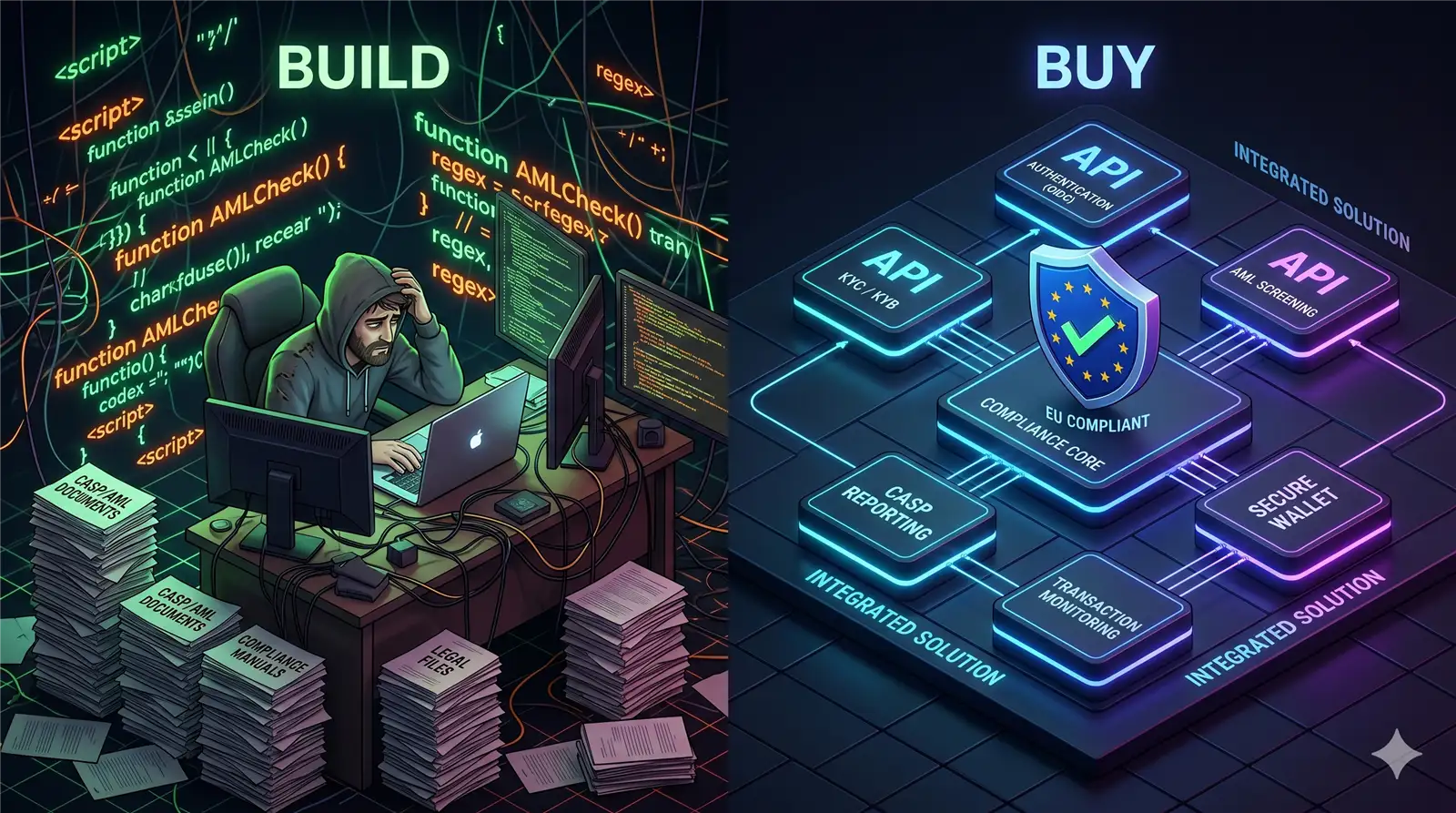
This post covers the full decision: technical tradeoffs and compliance ownership together.
What you'll learn
- Every web3 game backend comparison you'll find online skips the most important variable: compliance ownership.
- If your backend handles wallets or tokens but isn't MiCA-licensed, you personally own the CASP registration problem, regardless of which platform you chose.
- Year-one CASP costs run €500K–€1M. For most indie and mid-market studios, that's not viable.
- The only realistic path to EU market access without owning a licence yourself is a platform that holds it at the infrastructure level.
The Standard Build vs Buy Framework
The technical build vs buy question is real and worth answering first.
Speed. A managed backend platform (Sequence, Beamable) gets you to a working wallet and marketplace prototype in days. Building your own (smart contracts, custody layer, KYC integration, marketplace logic) takes months of senior engineering time.
Cost. Platform fees are ongoing (usually a revenue share or per-seat model). Build costs are front-loaded: engineering salaries, infrastructure, security audits. For most studios under Series A, build is more expensive in years one and two even before compliance enters the picture.
Control. Building gives you full control over the data model, chain choice, and feature set. Platforms constrain you to their supported chains, their APIs, and their roadmap. If the platform makes a breaking change, you adapt or migrate.
Scalability. Managed platforms handle infrastructure scaling for you. Custom builds require ops capacity. For early-stage studios, this is frequently underweighted, until the game grows.
Vendor risk. Platform dependency is real. Several web3 infrastructure companies have shut down or pivoted in the last two years. A platform that disappears takes your custody layer with it: see what happens when an infrastructure partner loses its MiCA licence for a worked example.
The standard framework produces a reasonable answer: most studios with under 10 engineers should lean toward a managed platform. It’s faster and cheaper through the early stages.
But this framework has a hidden assumption baked in: that the platform you choose is handling the regulated parts of the stack.
It usually isn’t.
The Variable Nobody Mentions: Compliance Ownership
Here is the part of the build vs buy decision that platform vendors have no incentive to tell you.
Under the EU’s MiCA regulation, any entity offering crypto-asset services to EU players needs a CASP authorisation (Crypto-Asset Service Provider licence). The services that require it include:
- Custody and administration of crypto-assets on behalf of clients (custodial wallets)
- Operation of a trading platform for crypto-assets (in-game marketplace)
- Exchange of crypto-assets for fiat or other crypto-assets (fiat on-ramp, token swap)
- Transfer services for crypto-assets (player-to-player transfers)
If your game does any of these things and serves EU players, CASP is required. MiCA applies based on where players are located, not where the studio is incorporated. A US studio, a UK studio, a Singapore studio: all within scope if EU players can access the game.
Now here is where the build vs buy decision intersects with compliance:
If you build your own backend: you own the CASP problem outright. You need the licence, the compliance function, the capital reserves, the ongoing reporting obligations.
If you use a non-licensed platform: you still own the CASP problem. The key question under MiCA is: who has the direct service relationship with the player? Sequence, Beamable, and AccelByte are B2B software vendors: their SDKs run inside your game, but your studio is the entity the player interacts with. The player has an account with your studio, not with Sequence. That makes your studio the service provider, and your studio the entity that needs the authorisation.
The analogy is Twilio: if you use Twilio to send SMS to your users, you are the sender: Twilio is a technical vendor. The B2C relationship belongs to you. It would be different if a platform provided a service directly to players under its own brand (the player has an account with the platform, not with you); in that case the platform might be the CASP. Sequence, Beamable, and AccelByte do not do this. They are purely B2B infrastructure, so the CASP obligation stays with the studio.
Note: ESMA has not yet published definitive guidance on all outsourcing chain scenarios, so edge cases should be verified with legal counsel.
If you use a licensed platform: the regulated layer is handled at the platform level. The platform holds the CASP, operates the compliant custody and marketplace infrastructure, and the studio operates under the platform’s regulatory perimeter.
Most build vs buy comparisons skip this entirely. The compliance question only becomes visible when a lawyer or regulator raises it, usually at the worst possible moment.
What Compliance Ownership Actually Costs
If you decide to build your own web3 backend and serve EU players, CASP is a line item in your budget. Here is what that line item looks like.
Capital reserves. Article 67 of MiCA requires CASP entities to hold own funds proportional to their licence class:
- Class 1: €50,000
- Class 2: €125,000
- Class 3: €150,000
Or 25% of prior year fixed overhead, whichever is higher. These funds must be CET1 (Common Equity Tier 1) capital or qualifying insurance from an authorised insurer. Crypto holdings do not count. The capital is not escrowed, but the floor must be maintained at all times: burn below it and the licence is in breach.
Qualified personnel. MiCA requires a compliance officer, an AML officer, and board members who meet fitness and propriety standards. A minimal compliance function: €200,000–€500,000 annually.
Legal counsel. Drafting the application, regulatory advisory, NCA submissions: €100,000–€300,000 year one.
Application and audit fees. Application fees range from €2,000 to €50,000 depending on jurisdiction. Annual external audits: €50,000–€100,000.
Timeline. From preparation to approval: 6 to 12 months in a best-case scenario. The NCA can pause the clock to request additional information.
Total year-one cost before any product work: €500,000–€1,000,000.
For reference, that is the seed funding of most indie studios.
Platform Comparison: Technical + Compliance
| Sequence | Beamable | Genesis Engine | |
|---|---|---|---|
| Custodial wallets | Yes | Limited | Yes |
| In-game marketplace | Yes | No | Yes |
| Multi-chain support | Yes (EVM) | No | Yes |
| Fiat on-ramp | Via third party | No | Yes |
| KYC/AML tooling | No | No | Yes |
| MiCA CASP licence | No | No | In progress (SE) |
| EU market access | Studio must handle | Studio must handle | Platform-level |
| Compliance ownership | Studio | Studio | Platform |
| CASP cost to studio | Full €500K–€1M | Full €500K–€1M | Covered by platform |
| Time to EU compliance | 6–12 months | 6–12 months | Weeks |
| Pricing model | Transaction fee | Per-seat / revenue share | % of GMV |
| Chain lock-in | EVM chains | None (no chain) | Chain-agnostic |
Technical evaluation of Sequence, Beamable, and AccelByte is legitimate. They are real products with real engineering quality. The table above is not an argument that they are bad platforms. It is an argument that the comparison is incomplete if compliance ownership is left out.
Choosing Sequence or Beamable for your web3 backend is a valid technical decision. It is not a compliance decision. Those are separate questions, and most studios treat them as one.
Which Studios Should Build, Which Should Buy, and Which Should Use a Licensed Platform
Build your own backend is the right call if you meet all of these:
- Well-funded (Series B+)
- 10+ engineers with web3 and security experience
- Long time horizon (12+ months before launch)
- Existing regulatory expertise or budget for a full compliance function
- Serving a market where CASP costs are worth the control gained
Very few studios meet this bar. Those that do are usually large-scale publishers with existing legal infrastructure, or protocol-native teams where the backend is itself the product.
Buy a non-licensed platform makes sense if:
- You are building for non-EU markets only (and intend to geo-block EU)
- You are in early prototyping and compliance is not yet a constraint
- You have a separate compliance path already in progress
The catch: if EU is in your roadmap at any point, the build-on-non-licensed-platform path means a future migration or a standalone CASP application. Neither is cheap.
Use a licensed platform is the right call if:
- You are a studio under Series B
- You want EU market access without owning a CASP
- You have a game shipping in under 12 months
- Your team’s core competency is game development, not regulatory compliance
For most indie and mid-market studios, this is the only viable path to EU access. The platform model is not a compromise. It is the only realistic option for studios that cannot capitalize a compliance function.
The EU Factor: Non-EU Platforms Don’t Give You EU Market Access
This is worth being explicit about.
Sequence (formerly Horizon Blockchain Games) is headquartered in Toronto, Canada and was acquired by Polygon Labs. Beamable is a US company. AccelByte is a US company. None of them hold a MiCA CASP licence.
Using any of these platforms to build a web3 game and then launching to EU players does not give you a compliant path to EU distribution. You are still the entity providing crypto-asset services to EU-based consumers. You still need the licence.
The EU is not a small market. Approximately 450 million people. Roughly 100 million active gamers. The largest single regulated crypto-asset market in the world.
Geo-blocking the EU is a choice. It is also an increasingly costly one as the regulated European market develops and non-compliant games find themselves locked out of app stores, payment rails, and institutional partnerships.
The only way to access the EU market without owning a CASP yourself is to operate under a platform that holds the licence. That is not a technicality: it is the structural reality of how MiCA works.
The Real Cost of Ownership
The build vs buy decision is usually framed as: build costs more upfront, buy costs more over time.
The compliance dimension inverts this for most studios.
Building in-house means owning the full compliance function. At €500K–€1M year one, that cost is front-loaded and non-negotiable. Buying from a non-licensed platform defers the compliance question. It does not solve it. Buying from a licensed platform bundles the compliance cost into the platform fee, typically a low single-digit percentage of GMV.
For a studio generating €1M in GMV in year one, the licensed platform fee is €20K–€50K. The CASP alternative is €500K–€1M before a single player transacts.
The platform model is not just faster. For most studios, it is the only financially coherent path.
FAQ
If I use Sequence for wallets, don’t they handle the compliance?
No. Sequence is a B2B software vendor: its SDK runs inside your game, but your studio is the entity with a direct service relationship with the player. The player has an account with your studio, not with Sequence. Under MiCA, the CASP obligation falls on whoever is providing the crypto-asset service to end users, which is your studio. Sequence does not hold a MiCA CASP licence and does not assume your regulatory obligations by virtue of being a technical dependency in your stack.
Can I launch in the EU and apply for CASP later?
Serving EU players without authorisation is not a grey area. MiCA is in force. Launching and applying later means you are operating without authorisation during the application period, which exposes the studio to enforcement, public warnings, and fines.
What if I just use non-custodial wallets?
Non-custodial wallet integration (MetaMask, WalletConnect) removes the custody trigger. But if your game runs a marketplace or processes token transfers between players, those services may still require CASP. Non-custodial wallet connection is not a full compliance workaround. It depends on what the game does after the wallet connects.
Does CASP cover the whole EU?
Yes. A CASP licence from any EU member state gives access to all 27 member states via passporting. The studio applies to one National Competent Authority (Malta, Lithuania, Sweden, etc.) and can serve EU-wide.
What does “compliance ownership” cost on a licensed platform?
On Genesis Engine, compliance is bundled into the platform fee: a percentage of GMV, low single digits. There is no separate application, no capital reserve requirement, and no compliance officer to hire. Once CASP authorisation is in place (in progress with Finansinspektionen, Sweden), studios on the platform operate under that coverage.
- What Does a Crypto Gaming License Actually Cost in 2026?
- CASP Licensing for Web3 Game Developers: A Practical Guide
- Web3 Game Compliance: Why Most Studios Can’t Launch in 2026
- Genesis Engine: Web3 Gaming Infrastructure
Genesis Engine is pursuing CASP authorisation with Finansinspektionen (Sweden) and provides the licensed infrastructure as a platform layer. Studios that want EU market access without owning a CASP can apply to join the waitlist.
— Magnus
All posts